Real-Time Stream Processing
Status: DRAFT v0.1 — part of the Patterns "at enterprise scale" set.
Enterprises that run on high-volume, time-ordered data — market-data ticks, trade events, device telemetry, clickstreams — need a processing model the request/response and per-message patterns don't give them: an ordered stream, processed with backpressure, windowed and partitioned, with checkpointed at-least-once progress. Benzene has a first-class streaming binding for exactly this, distinct from its per-message transports. This document explains it and works a financial market-data pipeline through it.
Stream vs. fan-out — two different models
Benzene deliberately offers two shapes for a batch of inbound records, and choosing correctly is the first design decision:
| Fan-out (SQS) | Stream (Kinesis / Event Hubs) | |
|---|---|---|
| A batch of N records is… | N pipeline invocations, one per record | one pipeline invocation over the whole batch |
| Order | order-agnostic, processed concurrently | shard-ordered, preserved |
| Failure | per-record: only failed records retried | resume the whole batch from the first failed sequence number |
| Use for | independent work items (jobs, commands) | ordered event streams where sequence and windowing matter |
The stream model is the one that keeps per-key order and lets you window and aggregate — the things a fan-out throws away. Reach for it whenever the order of records, or a rolling computation over them, is part of the problem.
(informative, .NET) Kinesis is UseKinesisStream(...); Azure Event Hubs is the mirror
UseEventHubStream(...); a Cosmos change-feed streaming binding exists too. The operators below are
transport-neutral — they work on the stream from any of them.
How you build it with Benzene
The stream handler
The streaming binding hands your pipeline the whole batch as a lazily-iterated
IAsyncEnumerable<TRecord> — you pull records, and the pull is the backpressure:
(informative, .NET)
app.UseAwsLambda(events => events
    .UseKinesisStream(stream => stream
        .UseStream<KinesisEventRecord>(async (records, ct) =>
        {
            await foreach (var record in records.WithCancellation(ct))
            {
                var tick = Deserialize<Tick>(record.Kinesis.GetDataAsString());
                // … process in shard order …
            }
        })));
- The records arrive as
IAsyncEnumerable<KinesisEventRecord>, iterated lazily — decode and process one at a time; nothing buffers the whole shard into memory unless you ask it to. - Cancellation rides on the context, not the signature — the
ctyou get is the invocation's token (the pipeline signature carries none, so it stays identical across transports). - Decode each record with
record.Kinesis.GetData()/GetDataAsString()(records arrive base64;PartitionKey,SequenceNumber, andApproximateArrivalTimestampare on the record).
Partition and window
Two transport-neutral operators turn a raw stream into aggregatable groups:
Window(n)— fixed-size windows, lazy and order-preserving (the final window may be smaller). Use it for rolling fixed-count aggregation over an unbounded stream; it does not buffer the whole stream.PartitionBy(keySelector)— groups the batch into per-key sub-streams, order preserved within each key, keys yielded in first-seen order. Partition on the record's partition key to restore the per-shard grouping the poller flattened.
Accuracy caveat, by design:
PartitionBybuffers the whole batch to group it, so it is for bounded batches — which a single stream invocation is — not for holding an infinite stream in memory. Within one Lambda batch (one shard's chunk) it is exactly right; do not use it as if it streamed lazily.Windowis the lazy one.
Checkpointing and at-least-once
The stream binding tracks a monotonic checkpoint (it only ever advances). On success it auto-checkpoints to the end of the batch; on failure the last checkpoint is what the response reports, and — because Kinesis/DynamoDB streams are shard-ordered — AWS resumes the whole batch from the first failed sequence number. That gives you at-least-once, in order: a record is never skipped, and a mid-batch failure replays from the failure, not from zero. (Event Hubs' binding is fan-in and ordered but does not itself wire a checkpointer/result — its progress is the platform's.)
Because delivery is at-least-once, a record can be reprocessed — so aggregation must be idempotent
or replayable (upsert the bar, don't blindly +=). This is the same discipline the
outbox and read models already require.
Worked example: a market-data tick pipeline
The system: ingest a firehose of market-data ticks (symbol, price, size, timestamp), roll them into one-minute OHLC bars (open/high/low/close/volume) per symbol, and publish each closed bar for downstream valuation and charting.
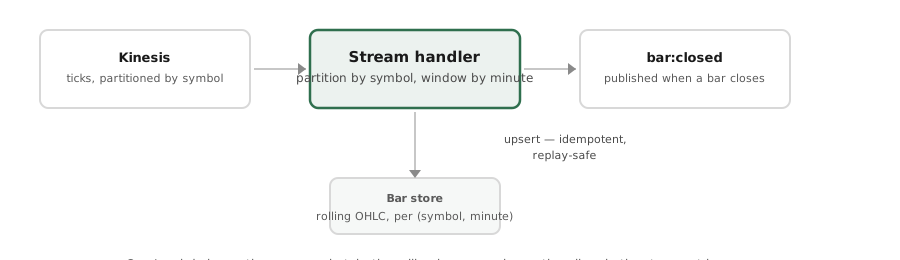
Ingress. Ticks land on a Kinesis stream, partitioned by symbol (the producer sets the partition key to the symbol), so all of one symbol's ticks share a shard and stay ordered. A Benzene stream Lambda consumes it.
Aggregate. Within each invocation the handler partitions the batch by symbol and folds each symbol's ticks into its current bar:
(informative, .NET)
.UseStream<KinesisEventRecord>(async (records, ct) =>
{
    // Partition on the record's native partition key (the producer set it to the symbol), so no
    // decode is needed to group. PartitionBy buffers this batch and preserves per-symbol order.
    await foreach (var symbolGroup in records.PartitionBy(r => r.Kinesis.PartitionKey).WithCancellation(ct))
    {
        var symbol = symbolGroup.Key;
        var ticks = symbolGroup.Value.Select(r => Deserialize<Tick>(r.Kinesis.GetDataAsString()));

        foreach (var minute in ticks.GroupBy(t => t.Timestamp.TruncateToMinute()))
        {
            var bar = Ohlc.From(minute);              // open/high/low/close/volume for that minute
            await _bars.UpsertAsync(symbol, minute.Key, bar);   // idempotent: replay-safe
            if (bar.IsClosed)
                await _sender.SendAsync<BarClosed, Void>("bar:closed", new BarClosed(symbol, bar));
        }
    }
})
Cross-invocation state. Each Lambda invocation sees one batch, so a bar that spans several
invocations is accumulated in a store (the UpsertAsync above — a per-(symbol, minute) item),
not in memory. In-memory Window/PartitionBy handle ordering and grouping within a batch; the
rolling state across batches lives in the store. Be explicit about that boundary — it is the one
thing newcomers get wrong about serverless streaming.
Egress. A closed bar is published as a bar:closed event — from here it is ordinary
choreography: a valuation service revalues positions on the new price, a charting
read model projects the bar into a query view, an alerting service watches for
thresholds. None of them know they are downstream of a Kinesis shard.
Throughput. A stream's parallelism is its shard count — more shards, more concurrent
invocations, order preserved within each shard's key. For the self-hosted streaming transports
(Kafka, RabbitMQ workers), throughput is instead bounded by ConcurrentRequests (default 5), which
drives a BoundedConcurrentDispatcher — N concurrent lanes, and with a per-partition key selector,
strict FIFO per partition while running many partitions at once. (The AWS Lambda stream path scales
by shards, not that dispatcher.)
Streaming request/response (a different tool)
The binding above is for ingesting a stream. Benzene also lets a handler itself take or return
a stream — IMessageHandler<IAsyncEnumerable<TRequest>, IAsyncEnumerable<TResponse>> — realized
today by the gRPC transport, which supports all four modes (unary, server-, client-, and
bidirectional-streaming) over HTTP/2. Use that for a low-latency streaming RPC between services
(a live price feed a caller subscribes to); use the Kinesis/Event Hubs binding for durable,
checkpointed ingestion of a firehose. They are different tools for different jobs — don't reach for
a queue-shaped stream when you want an RPC, or vice versa.
When to use it
- Use it when records are time-ordered and the computation is a rolling aggregation, windowed reduction, or anything where sequence matters — market data, telemetry, CDC, metering.
- Don't use the stream model for independent work items with no ordering relationship — that is a fan-out (SQS), which parallelizes freely and retries per-record. Using a stream for order-agnostic work throws away parallelism for ordering you don't need.
Checklist
Stream processing is well-formed when:
- Ordered, windowed, or rolling computations use the stream binding; independent work uses fan-out.
- The stream is partitioned by the key whose order matters (symbol, account, device).
- Records are pulled lazily; only bounded, within-batch grouping uses
PartitionBy. - Rolling state across invocations lives in a store, not in memory.
- Aggregation is idempotent/replayable, because delivery is at-least-once with resume-from-sequence.
- Throughput is sized by shards (AWS) or
ConcurrentRequests(self-hosted workers).
See also: map-reduce & high-volume compute (when each record needs heavy calculation), and choreography (what consumes the events a stream emits).