Reference Solution: A Real-Time Risk & Trading Platform
Status: DRAFT v0.1 — a worked reference solution in the Patterns "at enterprise scale" set.
The individual patterns show one technique each. This document assembles them into one named system of the kind a large financial enterprise actually asks to have designed — a platform that ingests live market data, revalues a large trading book in real time and in batch, serves fast cross-cutting queries, keeps an immutable audit trail, and offers low-latency pricing to other desks. It is a worked example, not a product: every box is a Benzene service, and every arrow is one of the patterns.
The point is to show how the pieces compose — that these are not competing patterns but layers of one system.
The system
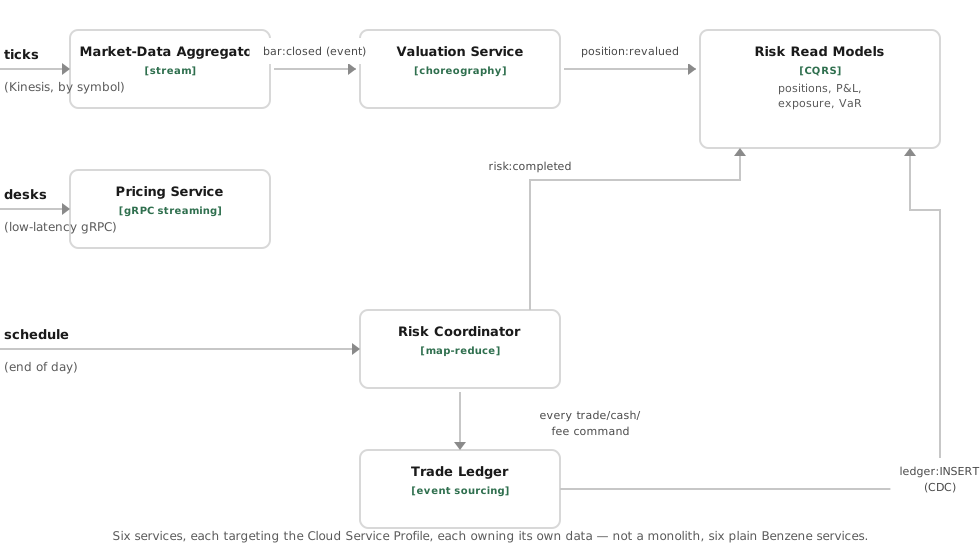
Six services, each a plain Benzene service targeting the Cloud Service Profile, each owning its own data (share-nothing), each addressed by topic. The whole thing is the two-tier architecture — core services (ledger, valuation), orchestrators (risk coordinator), read models — with its event-driven half doing the heavy lifting.
The flow, pattern by pattern
1. Ingest market data — stream processing
The Market-Data Aggregator consumes a Kinesis firehose of ticks, partitioned by symbol so
each symbol's ticks stay shard-ordered. It rolls them into one-minute OHLC bars (idempotent upserts,
rolling state in a store because each invocation is one batch) and emits bar:closed per closed bar.
Throughput scales with shard count; order is preserved per symbol; checkpointing gives at-least-once,
in-order progress.
Why Benzene: the UseKinesisStream binding gives ordered fan-in, PartitionBy/Window do the
per-symbol grouping, and the checkpoint contract handles resume-from-sequence — no bespoke stream
plumbing.
2. Revalue in real time — choreography
The Valuation Service subscribes to bar:closed and revalues every position exposed to that
symbol, emitting position:revalued. It knows nothing about who produced the bar or who consumes the
revaluation — it just reacts. New reactions (a limit-monitor, a hedging trigger) are added as new
subscribers without touching valuation.
Why Benzene: an event is a topic; a reaction is a handler; the mesh draws the live "what reacts to what" graph from trace parentage, so this decoupled flow is still fully observable.
3. Serve cross-cutting queries — CQRS & read models
Risk Read Models project position:revalued, risk:completed, and ledger events into
denormalized views built for specific questions — current positions per desk, live P&L, exposure by
counterparty, VaR by book. These are queries no single core service can answer (they span the
ledger, valuations, and reference data), served as single fast reads instead of runtime fan-outs.
Why Benzene: the read model is a normal service — event handlers project, query handlers serve — and it stays share-nothing, owning its query store. Read the read model for cross-aggregate views; read the core service directly when you need read-your-writes.
4. End-of-day risk — map-reduce
The Risk Coordinator fires on a schedule, partitions the book into shards, and scatters
risk:shard across a burst of hundreds of stateless Lambda workers (BoundedFanOut cap), each
revaluing its slice against the day's curves and returning a partial risk vector. The coordinator
folds the partials into the firm-level number and emits risk:completed. A job that is hours serial
is minutes parallel.
Why Benzene: the scatter is a bounded fan-out over SendAsync resolving to Lambda-to-Lambda
invokes (burst-cheap) and the reduce a deterministic fold (results in shard order) — packaged
together as Benzene.MapReduce's ScatterGatherAsync, whose explicit partial-failure policy means a
regulatory number is never silently under-covered.
5. The book of record — event sourcing
The Trade Ledger is the system of record. Every trade, cash movement, and fee is a command
handler that appends an immutable, ordered event to a DynamoDB log (conditional write for
optimistic concurrency). The log's stream feeds the projections (step 3) and is the audit trail:
point-in-time reconstruction is a replay of the pure fold; years of schema drift are absorbed by
upcasting historical events on read (AddPayloadVersioning).
Why Benzene: command handlers ingest, DynamoDB-Streams CDC projects in order at-least-once, payload
versioning evolves the events, idempotency makes replay converge, and Benzene.EventSourcing's
IEventStore is the append (optimistic concurrency built in) — the ledger is composed almost
entirely from built-ins, with the rehydration fold the main app-owned piece.
6. Low-latency internal pricing — gRPC
The Pricing Service offers other desks a low-latency, streaming price/greeks feed over gRPC (HTTP/2, protobuf, bidirectional streaming), with deadlines propagated end to end. Internal callers that need microsecond-sensitive request/response or a live subscription use this rather than the event bus.
Why Benzene: the same IMessageHandler shape serves gRPC (including all four streaming modes); the
service is still topic-routed and result-status-mapped, so it is a Benzene service that merely speaks
a faster wire to its neighbours.
What makes this hold together
- One model, many transports. Kinesis, SNS/EventBridge, Lambda-to-Lambda, DynamoDB Streams, gRPC, a schedule — every service is the same pipeline-and-handlers core behind a different adapter. The architecture is transport choices, not framework rewrites.
- Reliability is layered, not bolted on. The outbox/CDC guarantees no event is lost; idempotent consumers make at-least-once safe; the saga (inside the coordinator and any atomic booking flow) keeps multi-service writes all-or-nothing. Nothing lost, nothing double-applied — the contract a trading platform lives or dies by.
- The whole estate is visible. Every service targets the Cloud Service Profile, so the mesh gives live topology, health, schemas, and — from trace parentage — the real event-flow graph across all six services, derived from traffic rather than a diagram someone has to keep current.
- It degrades sensibly. A slow read model lags but never blocks a trade; a failed risk shard is retried or flags reduced coverage; a dropped market-data batch resumes from its checkpoint. No single failure takes the platform down, because the couplings are events and bounded calls, not shared state.
Building it, in order
A team (or an agent) can stand this up incrementally — each step is independently useful:
- Trade Ledger first — the book of record (event sourcing); everything else derives from its events.
- Risk Read Models — project the ledger into query views (CQRS); now the business can see the book.
- Market-Data Aggregator + Valuation — bring in live prices (stream + choreography); positions revalue in real time.
- Risk Coordinator — the end-of-day number (map-reduce).
- Pricing Service — low-latency internal feed (gRPC) once neighbours need it.
Each rung is a shippable system on its own — the adoption ladder applied to a whole platform, not just one service.
See also — the patterns this solution composes: two-tier architecture, stream processing, map-reduce, event sourcing, CQRS & read models, choreography, transactional outbox, service communication.