Orchestrators
Status: DRAFT v0.1 — part of the two-tier pattern.
An orchestrator owns a business process. Where a core service is a guarded database, an orchestrator is a coordinator: it takes a request or an event, drives a sequence of operations across several core services, emits events about what happened, and makes the whole multi-service change atomic — it either fully succeeds or is fully undone.
Orchestrators are where the business logic of the system lives. Core services are deliberately dumb so that orchestrators can be the one place a process is expressed, changed, and understood.
What an orchestrator is
- Triggered by a request or an event. An orchestrator's front door is any Benzene transport: an API Gateway request (request/response), a queue or topic message (SQS, SNS, EventBridge), a schedule, a stream. The same orchestrator logic can sit behind more than one — see Triggers.
- Drives a process across core services. Its steps are calls to core-service topics —
tenant:create,user:create,billing:setup— composed into a business process. It reads from and writes to several aggregates that no single core service may touch together. - Emits events. On completion (and often on failure) an orchestrator publishes an event —
signup:completed,signup:failed— for the rest of the estate to react to. This is how processes chain without orchestrators depending on each other directly. - Owns little or no persistent state. The system of record is the core services. An orchestrator is ideally stateless between invocations; what state it does hold is the transient state of an in-flight process (a saga's progress), which exists only until the process finishes or is compensated.
- Makes multi-service writes all-or-nothing. This is the non-negotiable one, and it is what the rest of this document is about.
Triggers
An orchestrator is transport-neutral in exactly the way every Benzene service is (core-concepts.md): the process logic is written once, and one or more transport adapters feed it. Two broad shapes:
- Request/response — an API call comes in, the orchestrator runs the process synchronously and
returns a result (
201 Createdwith the new ids, or avalidation-error/conflict/service-unavailableresult). The caller waits for the whole process. - Event-driven / fire-and-forget — a message arrives (a queue item, a published event, a schedule firing), the orchestrator runs the process and emits events rather than returning to a caller. Nobody is waiting on the wire; the outcome is communicated by the events it publishes.
The same process can be exposed both ways. What differs is only the adapter at the edge and whether a result is returned or an event is emitted — the process in the middle is identical.
Because the outcome of an event-driven process is only visible through its emitted events, an
orchestrator should emit on failure as deliberately as on success: a signup:failed event with
a reason is how the rest of the system (and your operators) learn that a fire-and-forget process
rolled back.
The saga pattern
The core services each write atomically to their own database. But a business process usually writes to several of them — create a tenant, create its admin user, set up billing — and there is no distributed transaction across three databases. If the second write fails, the first is already committed. The saga pattern is how an orchestrator gets atomicity across services anyway: not by holding a lock, but by pairing every forward action with a compensation that undoes it, and running the compensations in reverse if anything fails.
The invariant the orchestrator guarantees: total success, or total rollback — never a half-applied process. A signup that fails at billing must leave no orphan tenant and no orphan user behind.
Shape (informative, .NET — Benzene.Saga)
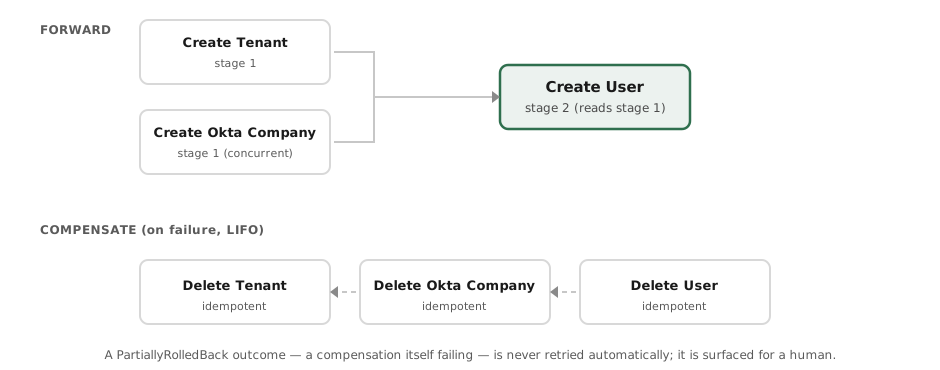
A saga is an ordered list of stages; each stage is a group of steps that run concurrently; stages run in order, threading their results through a shared context. Each step is a forward action paired with the compensation that undoes it:
var saga = new SagaBuilder()
    .Stage(stage => stage
        .Step<TenantCreated>(step => step
            .Do(_       => api.CreateTenantAsync(companyName))
            .Compensate((_, tenant) => api.DeleteTenantAsync(tenant.TenantId)))
        .Step<OktaCompanyCreated>(step => step
            .Do(_        => api.CreateOktaCompanyAsync(companyName))
            .Compensate((_, company) => api.DeleteOktaCompanyAsync(company.CompanyId))))
    .Stage(stage => stage
        .Step<UserCreated>(step => step
            // later stages read earlier results from the shared context
            .Do(ctx => api.CreateUserAsync(ctx.Get<TenantCreated>().TenantId, email))
            .Compensate((_, user) => api.DeleteUserAsync(user.UserId))))
    .Build();

var result = await saga.RunAsync();
The engine's contract:
- Stages run in order; steps within a stage run concurrently. Independent effects (create the tenant and the Okta company) parallelize; dependent effects (create the user, which needs the tenant id) go in a later stage that reads the earlier result from the context.
- On any failure, every completed effect is compensated in reverse (LIFO) order. If stage 2 fails, stage 1's tenant and Okta company are deleted — newest effect undone first. The process ends wholly rolled back.
- A succeeded step with no compensation is "nothing to undo" — pure reads or idempotent effects
need no
Compensate. Compensation only ever runs for a step that actually succeeded. - Each step's
Dois a call to a core service. In production the forward action is a Benzene request/response call —send("tenant:create", req)— and its compensation is another topic call (send("tenant:delete", …)). The saga is the orchestration; the core services do the work. See service-communication.md for how those calls are addressed and routed.
Outcomes and durability
Running a saga yields one of three outcomes, and the difference between the last two matters:
| Outcome | Meaning |
|---|---|
Succeeded |
Every step completed; the process is applied. |
RolledBack |
A step failed and every compensation succeeded — the system is clean, as if nothing happened. |
PartiallyRolledBack |
A step failed and a compensation also failed — some effect may still be applied. This needs attention: it is the one state the invariant could not fully restore. |
(informative, .NET) Saga.RunAsync(SagaRunOptions) can attach a durable ISagaStateStore (so an
interrupted saga can be recovered) and a SagaRetryPolicy. The retry rule is deliberately
conservative: only a clean RolledBack outcome is retried — a PartiallyRolledBack one, which
may have left effects behind, is never retried automatically, because retrying on top of a
possibly-applied effect is how you double-charge a customer. A PartiallyRolledBack is surfaced
(emit a failure event, alert) for a human or a dedicated repair process to resolve.
Designing compensations
The saga is only as atomic as its compensations. Rules that keep it honest:
- Every effectful forward step has a compensation. If you cannot write one, question whether the step belongs in the saga — or make the effect idempotent and externally reversible first.
- Compensations must be idempotent. A compensation may run after a partial failure and may be retried; deleting an already-deleted tenant must be a no-op success, not an error.
- Prefer reversible effects over irreversible ones inside a saga. Sending an email or charging a card is hard to compensate; where possible, stage irreversible effects last (so everything that could fail has already succeeded) or move them out of the atomic process entirely and drive them from the success event.
- Order effects so the most likely failure is cheapest to undo. Cheap, easily-reversed writes early; expensive or externally-visible effects late.
Orchestrators and the mesh
An orchestrator is a Benzene service like any other and should target the Cloud Service Profile too — its handlers, health, and mesh feeds make the process layer as visible as the data layer. Because orchestrators are the services that call across the fleet, their trace-context propagation (R8) is what draws the edges in the mesh topology: "the signup orchestrator calls tenant:create, user:create, and billing:setup" is derived from the traces the orchestrator propagates, not declared anywhere. Keep propagation on and the mesh shows your business processes as real, observed call graphs.
Checklist
A service is a well-formed orchestrator when:
- It owns a business process, not an aggregate's data.
- It is stateless between invocations except for transient in-flight saga state.
- Its steps are calls to core-service topics, addressed by topic (see service-communication.md).
- Every multi-service write is a saga with a compensation for every effect.
- Compensations are idempotent; irreversible effects are staged last or moved out of the atomic process.
- It emits events on success and failure.
- It propagates trace context so the mesh derives its process edges.
- It targets the Cloud Service Profile.
Next: how the calls between orchestrators and core services are addressed, routed, and realized on AWS — service communication.