Event Sourcing
Status: DRAFT v0.1 — part of the Patterns "at enterprise scale" set.
Regulated and audit-heavy domains — trading, payments, ledgers — often cannot store just the current state of an aggregate; they must store every change that led to it, as an immutable, ordered log. That is event sourcing: the aggregate's state is a fold over its event history, the log is the source of truth, and "what did this account look like last Tuesday?" and "prove how we got to this balance" are answerable by construction.
Benzene keeps its event-sourcing surface deliberately small. The Benzene.EventSourcing package
gives you an append-only event store with optimistic concurrency — IEventStore
(AppendAsync(streamId, expectedVersion, events) / ReadAsync), an InMemoryEventStore, and a
DynamoDB-backed store in Benzene.EventSourcing.DynamoDb — but there is no aggregate-rehydration
helper, no snapshot or replay framework: those you compose. Add a change-data-capture transport
that makes the projection half nearly free, and you have the whole pattern. This document is explicit
about that line, and works a trade ledger through it.
What Benzene gives you, and what you build
| Piece | Status |
|---|---|
| Command ingest — validate and decide | Built-in — a message handler ([Message("account:debit")] IMessageHandler<Debit, …>) is the command handler. |
| The event log — append-only, ordered | Built-in — Benzene.EventSourcing's IEventStore.AppendAsync(streamId, expectedVersion, events) is the append, with optimistic concurrency (a version clash throws EventStoreConcurrencyException); use InMemoryEventStore or the DynamoDB store (Benzene.EventSourcing.DynamoDb, one item per (streamId, version)). You can still hand-roll the write against your own data layer if you prefer. |
| Projections — turn events into read state | Built-in transport — point DynamoDB Streams at the log and consume it with UseDynamoDb ([Message("ledger:INSERT")]); Benzene delivers each appended event, in shard order, to a projector. This is CQRS fed by the log. |
| Idempotency / exactly-once effect | Built-in middleware — UseIdempotency() (+ a durable store) so a replayed event projects once. |
| Durable event evolution — old events, new code | Built-in — AddPayloadVersioning upcasts historical event schemas to the current shape at the pipeline edge (below). |
| Aggregate rehydration, snapshots, replay orchestration | App-level — you write these. Benzene.EventSourcing gives you the store (IEventStore), but deliberately imposes no aggregate base class, snapshotting, or replay driver. |
The honest summary: Benzene gives you the ingest, the event store, the stream-projection consumer, idempotency, and event versioning; you own the rehydration fold, snapshots, and the replay driver. That is a deliberate small surface — the storage and concurrency are handled, but the event-sourcing conventions above vary enough that a framework abstraction usually gets in the way.
How you build it with Benzene
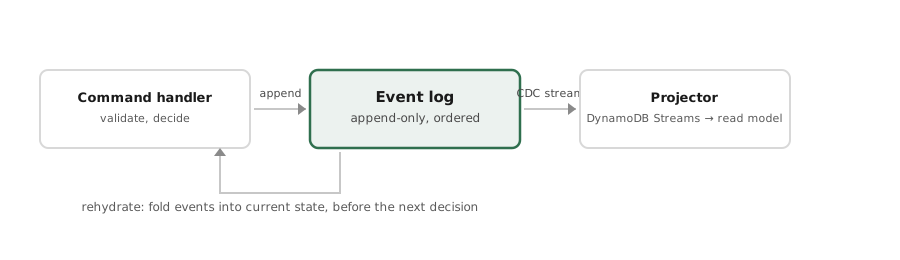
1. The command handler appends an event
A command handler validates, loads the aggregate's current state (a fold of its events, below), decides, and appends the resulting event(s) to the log — an ordinary write to the append store:
(informative, .NET)
[Message("account:debit")]
public class DebitHandler : IMessageHandler<Debit, DebitAccepted>
{
    private readonly IEventLog _log;   // Benzene.EventSourcing's IEventStore, or your own store
    public DebitHandler(IEventLog log) => _log = log;

    public async Task<IBenzeneResult<DebitAccepted>> HandleAsync(Debit cmd)
    {
        var account = await Rehydrate(cmd.AccountId);           // fold events → current state (app code)
        if (account.Balance < cmd.Amount)
            return BenzeneResult.Invalid("insufficient-funds");  // a decision, returned as a result
        var evt = new AccountDebited(cmd.AccountId, cmd.Amount, account.NextSequence);
        await _log.AppendAsync(evt);        // the append IS the DynamoDB write; ordered by sequence
        return BenzeneResult.Ok(new DebitAccepted(evt.Sequence));
    }
}
Two Benzene-shaped details that matter for correctness:
- The decision (
insufficient-funds) is a returned result, not a thrown exception — failure stays in the type, and the transport maps the status. - The append's optimistic concurrency (reject if the aggregate moved since you rehydrated) is
your store's conditional write — a DynamoDB
attribute_not_exists/version-check on(aggregateId, sequence). Benzene doesn't do this for you; the log does.
2. The log emits its events — via change data capture
You do not publish the event from the handler (that would be the dual-write problem). Instead, the append is captured off the log's stream and projected — the transactional outbox, applied to the event log itself:
app.UseAwsLambda(events => events
    .UseDynamoDb(cdc => cdc
        .UseIdempotency()
        .UseMessageHandlers()));

[Message("ledger:INSERT")]                 // a newly-appended event, in shard order
public class ProjectBalance : IMessageHandler<AccountEvent>
{
    private readonly IReadStore _view;
    public ProjectBalance(IReadStore view) => _view = view;
    public Task<IBenzeneResult> HandleAsync(AccountEvent e)
        => _view.ApplyAsync(e);            // fold the event into the read model
}
Because DynamoDB Streams are shard-ordered and processed sequentially, resuming from the first failed record, events project in order, at least once — exactly what a ledger needs. The read models this feeds are ordinary CQRS views: current balances, statements, positions — each a projection of the same authoritative log.
3. Rehydration and snapshots (your code, Benzene-friendly shapes)
- Rehydrate = read an aggregate's events in sequence and fold them into state. This is app code;
keep the fold pure (
(state, event) => state) so it is testable and identical to the projection fold. - Snapshots avoid re-reading a long history: periodically store a folded state at a sequence, and rehydrate from the latest snapshot forward. Also app-level — Benzene has no snapshot type — but the in-process pipeline makes it easy to replay events through the same projection handler you deploy.
- Replay = re-project the whole log into a fresh read model (fix a projection bug, add a view). Drive it by re-reading the log and invoking the projection handler in process (build the pipeline and call it directly), or by re-streaming. The projections' idempotent folds make replay a routine operation, not a migration.
4. Events are immutable — so version them, never rewrite them
An event, once written, is history and cannot be edited. When the event's shape must evolve, you keep the old events exactly as written and upcast them to the current shape as they are read — Benzene's payload-schema versioning does this at the pipeline edge:
// AddPayloadVersioning is registered on the Benzene container (inside UsingBenzene).
services.UsingBenzene(x => x.AddPayloadVersioning(v => v.ForContext<DynamoDbRecordContext>()
    .Topic("ledger:INSERT", t => t
        .Version<AccountDebitedV1>("v1")
        .Version<AccountDebitedV2>("v2")
        .Upcast<AccountDebitedV1, AccountDebitedV2>(f => f.RegisterInitValue(e => e.Currency, "USD")))));
One projection handler on the latest schema; a decade of historical v1 events upcast on read; the
caster graph validated at startup (a missing conversion path throws at boot, not on a 2015 event
in production). Chain composition handles a long back-catalog. This is the mechanism that makes an
append-only log survivable across years of schema change.
Worked example: a trade ledger
The system: every change to a trading account — trades booked, cash moved, fees applied — must be an immutable, ordered, auditable record; current positions and balances must be queryable fast; and "reconstruct the account as of any past instant" must be possible for audit and dispute.
- Commands (
trade:book,cash:move,fee:apply) are Benzene handlers. Each rehydrates the account, validates against current state, and appends an event to the DynamoDB event log, ordered by(accountId, sequence)with a conditional write for optimistic concurrency. - The log is the truth. Nothing updates state in place; state is a fold of events.
- Projections consume the log's stream (
UseDynamoDb,ledger:INSERT) and maintain read models: current positions, cash balances, a statement view — each a CQRS projection, in order, at least once, idempotent. - Audit / point-in-time is answered by replaying an account's events up to a sequence or timestamp through the pure fold — no separate audit system, because the log is the audit trail.
- Evolution: as the trade event shape changes over years, historical events are upcast on read
via
AddPayloadVersioning; the log is never rewritten. - Reliability: idempotent projections + at-least-once ordered CDC mean a redelivery or a full replay converges to the same balances — the property an auditor will ask you to demonstrate.
When to use it
- Use it when the history is a requirement, not a nicety — audit, regulation, dispute resolution, temporal queries ("as of"), or when several read models must derive from the same authoritative change log.
- Don't event-source a CRUD aggregate whose history nobody needs — a core service storing current state is simpler and correct. Event sourcing adds real complexity (rehydration, snapshots, event versioning, eventual-consistency reads); spend it where the history pays for it, not fleet-wide by default.
Checklist
Event sourcing is well-formed when:
- State changes are immutable, ordered events appended to a log; nothing updates in place.
- The append is the write to the log (no separate publish — CDC emits the event).
- Rehydration and projection use the same pure fold; projections are idempotent.
- Read models are CQRS projections of the log, in order, at least once.
- Historical events are upcast on read (
AddPayloadVersioning), never rewritten. - The choice is deliberate per aggregate — event-sourced where history is required, plain CRUD where it isn't.
See also: transactional outbox (the CDC mechanism that emits appended events), CQRS & read models (what the log projects into), and map-reduce (for replaying/aggregating a large log in parallel).