Event-Driven Choreography
Status: DRAFT v0.1 — part of the Patterns "composing a system" set.
The two-tier architecture drives processes with orchestrators: a central service issues commands to core services and runs a saga to keep the multi-service write atomic. Choreography is the other way to move a process across a fleet: no central conductor — each service reacts to events and emits its own, and the process emerges from the chain of reactions.
Both are first-class on Benzene, and a real system uses both. This document is about when to choreograph, and exactly how you build it with Benzene's events, transports, and mesh.
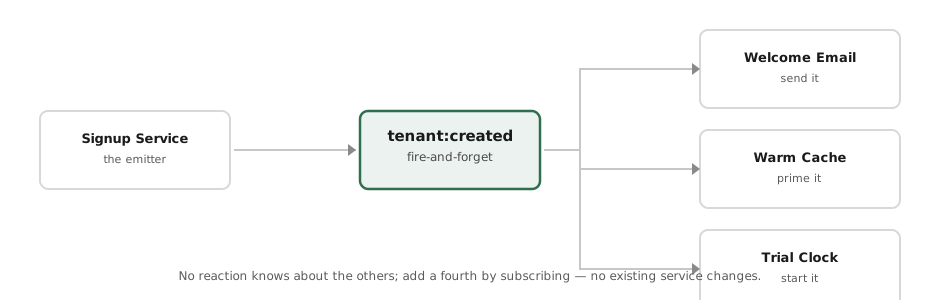
Orchestration vs. choreography
| Orchestration (orchestrators.md) | Choreography (this doc) | |
|---|---|---|
| Control | Central — one service directs the process | Distributed — each service decides its own reaction |
| Coupling | Orchestrator knows every step | Emitter knows nothing about who reacts |
| Atomicity | A saga: all-or-nothing across services | None built-in — each reaction succeeds/retries on its own |
| Adding a step | Edit the orchestrator | Add a new consumer; no existing service changes |
| Best for | An invariant that must hold across services (a signup that must not half-apply) | Fan-out reactions that are independently retryable (on signup: send a welcome email, warm a cache, start a trial clock) |
The rule of thumb: orchestrate what must be atomic; choreograph what must merely happen. A process usually has both — a small atomic core (orchestrated as a saga) that emits an event, and a spray of independent reactions (choreographed). Do not use choreography to hold a cross-service invariant; there is no central rollback, and reconstructing one out of scattered compensations is exactly the complexity the saga exists to remove.
How you build it with Benzene
An event is a topic
Choreography needs no new concept. A domain event — tenant:created, order:shipped — is a
topic like any other, and a reaction to it is an
ordinary message handler. The only thing that
makes it an "event" rather than a "command" is intent: nobody is waiting for a result, and the
emitter does not know or care who handles it.
Emitting an event
An emitter publishes fire-and-forget through the same outbound sender the
two-tier calls use — a topic and a payload, with a Void response type
so the caller does not wait:
(informative, .NET)
// Fire-and-forget: Void response type => no wait, no reply.
await sender.SendAsync<TenantCreated, Void>("tenant:created", new TenantCreated { TenantId = id });
Where tenant:created goes is a routing-table entry,
declared once at startup — SNS for fan-out, EventBridge for bus-routed events, SQS for a point-to-
point queue:
services.AddOutboundRouting(routing => routing
    .Route("tenant:created", pipeline => pipeline.UseSns(tenantEventsTopicArn))
    // or onto an EventBridge bus, where the topic becomes the event's detail-type:
    .Route("order:shipped",  pipeline => pipeline.UseEventBridge(source: "orders", eventBusName: "domain")));
Benzene tags the message so a Benzene consumer can route on it with no extra configuration:
- SNS / SQS put the topic in the
topicmessage attribute. - EventBridge maps the topic to the event's
detail-type, the source toSource, and embeds Benzene's wire headers (correlation id,traceparent) insidedetailunder a reserved key — because EventBridge has no native message attributes. The inbound side lifts them back out, so correlation and trace context survive the hop.
Reacting to an event
A reacting service mounts the matching inbound transport and writes a handler for the event topic — identical in shape to a command handler, because to Benzene it is one:
app.UseAwsLambda(events => events
    .UseSns(sns => sns.UseMessageHandlers())          // topic from the "topic" attribute
    .UseEventBridge(bus => bus.UseMessageHandlers())); // topic from detail-type

[Message("tenant:created")]
public class SendWelcomeEmailOnTenantCreated : IMessageHandler<TenantCreated>
{
    public async Task<IBenzeneResult> HandleAsync(TenantCreated message) { /* react */ }
}
Adding a second reaction is adding a second handler in a second service that subscribes to the same topic. The emitter is untouched, and never learns the reaction exists — that decoupling is the whole point of choreographing.
Events from non-Benzene producers
An event from an AWS service or a non-Benzene producer will not carry Benzene's topic attribute.
Two clean options:
- A queue (or subscription) per event type, and set the topic for everything on that pipeline
with
UsePresetTopic("s3:object-created")beforeUseMessageHandlers()— every message on that queue routes to a fixed topic.UseTopicFrom(ctx => …)is the dynamic version, computing the topic from the payload (a discriminator field, a routing key). (Preset/derived topics are supported on the queue-shaped transports — SQS, Service Bus, Event Hub, Queue Storage, and the self-hosted workers; check your transport before relying on it.) - EventBridge already carries a
detail-type, so a foreign bus event routes on that detail-type directly — declare a handler for it.
Choreography is visible in the mesh — for free
Choreography's classic drawback is that the flow lives nowhere: no orchestrator to read, so "what
reacts to what" is folklore. On Benzene it is not folklore. A consumer stamps traceparent from
the inbound event's span, and the mesh derives consumer edges from
that trace parentage — an event whose parent span belongs to another service makes this service a
consumer of that topic, never declared. Keep trace-context propagation
on (it is a Cloud Service Profile requirement) and the choreography graph draws itself in the fleet
view: every emitter, every reaction, observed from real traffic. The thing that makes choreography
hard to see everywhere else, Benzene gives you as a live diagram.
Reliability: at-least-once, so make reactions idempotent
SNS, SQS, and EventBridge are at-least-once — a reaction can be delivered more than once (a redelivery, a retry, a duplicate publish). Choreographed reactions must therefore be idempotent: processing the same event twice must have the same effect as once.
Benzene ships the seam for this — Benzene.Idempotency. Add UseIdempotency() to a reaction's
pipeline and it derives a key (an idempotency-key header if present, else a hash of topic+body),
atomically claims it in a store, and runs the handler only on the first sighting:
sns.UseIdempotency().UseMessageHandlers();
The in-memory store is single-process; for a fleet of Lambdas you supply an IIdempotencyStore
backed by an atomic conditional write (DynamoDB attribute_not_exists, Redis SET NX). Idempotent
reactions are what make at-least-once safe — and they are the same discipline the
outbox relies on downstream, and that a saga's compensations already
require.
There is no automatic cross-service rollback in choreography. If a reaction fails, it retries (and eventually dead-letters) on its own — the emitter has already moved on. Choreograph reactions that are safe to retry independently; keep anything that must be undone-as-a-unit inside an orchestrated saga.
Events are contracts
An emitted event is a published contract other services depend on — evolve it as carefully as a request type. Version an event's payload with payload-schema versioning so old consumers keep reading it, and give a breaking event a topic version rather than redefining the old topic under everyone's feet.
Checklist
Choreography is well-formed when:
- Events are topics, emitted fire-and-forget (
Voidresponse) via the routing table. - Emitters know nothing about consumers; a new reaction adds a consumer and changes no existing service.
- Reactions are idempotent (
UseIdempotency+ a distributed store), because delivery is at-least-once. - Cross-service atomic invariants stay in an orchestrated saga, not in choreography.
- Trace context is propagated, so the mesh shows the choreography graph.
- Events are versioned as the contracts they are.
See also: transactional outbox (so the events you choreograph on are never lost), and CQRS & read models (a major consumer of domain events).