CQRS and Read Models
Status: DRAFT v0.1 — part of the Patterns "composing a system" set.
The core services pattern is deliberately strict: each service owns one or two
aggregate roots, owns its own database (share-nothing), and references other aggregates
by id only. That strictness is what makes each service
independent — and it leaves one thing conspicuously unanswered: how do you query across
aggregates? "A tenant and all its users", "orders with the customer's name and the product
titles" — no single core service owns that data, and the directional rule
says the parent must not even know its children exist. core-services.md punts that question
explicitly, "above the core layer." This is that layer.
The idea: split reads from writes
CQRS — Command Query Responsibility Segregation — is the recognition that the model you write through and the model you read through want to be different. The core services are the write model: normalized, authoritative, one aggregate each, optimized for correct writes. A read model is a separate, derived, denormalized store shaped for a specific query — a materialized view assembled from the events the core services emit.
- The write side stays exactly as the two-tier pattern describes — untouched.
- The read side is a new service that consumes domain events and maintains a query-optimized projection it owns, then serves reads from it.
The read model holds no authority; it is a cache of a shape, rebuildable from the events that fed it. That is what lets it break the core layer's rules safely — it can hold "tenant + its users" together precisely because it is derived and disposable, not a source of truth.
How you build it with Benzene
A read model is, pleasingly, just another Benzene service — with event handlers on its write side (the projection) and query handlers on its read side. Both are ordinary message handlers.
1. Consume the domain events and project
Subscribe to the events the core services emit — delivered by choreography, made reliable by the outbox — and fold each one into the projection:
(informative, .NET)
app.UseAwsLambda(events => events
    .UseSqs(sqs => sqs
        .UseIdempotency()          // events are at-least-once; projecting twice must converge
        .UseMessageHandlers()));

[Message("tenant:created")]
public class ProjectTenant : IMessageHandler<TenantCreated>
{
    private readonly IReadStore _view;                        // this service's OWN denormalized store
    public ProjectTenant(IReadStore view) => _view = view;
    public async Task<IBenzeneResult> HandleAsync(TenantCreated e)
    {
        await _view.UpsertTenantAsync(e.TenantId, e.CompanyName);   // idempotent upsert
        return BenzeneResult.Ok();
    }
}

[Message("user:created")]
public class ProjectUserOntoTenant : IMessageHandler<UserCreated>
{
    private readonly IReadStore _view;
    public ProjectUserOntoTenant(IReadStore view) => _view = view;
    public async Task<IBenzeneResult> HandleAsync(UserCreated e)
    {
        await _view.AddUserToTenantAsync(e.TenantId, e.UserId, e.Email);  // the join the write side can't do
        return BenzeneResult.Ok();
    }
}
The projection service is still share-nothing — it owns its read store, no one else touches it.
What it relaxes is the shape: it deliberately co-locates data from several aggregates (tenant and
user) that no core service may hold together. It earns that by being derived, not authoritative.
2. Serve the queries
The read side is ordinary query handlers over the projection, exposed on whatever transport the
readers use — HTTP via UseApiGateway, or the wire envelope:
[Message("tenant:users:list")]
[HttpEndpoint("GET", "/tenants/{tenantId}/users")]
public class ListTenantUsersHandler : IMessageHandler<ListTenantUsers, TenantUsersView>
{
    private readonly IReadStore _view;
    public ListTenantUsersHandler(IReadStore view) => _view = view;
    public Task<IBenzeneResult<TenantUsersView>> HandleAsync(ListTenantUsers q)
        => _view.GetTenantWithUsersAsync(q.TenantId);   // one read, no fan-out
}
"A tenant and all its users" is now a single indexed read against a store shaped for exactly that question — instead of the runtime fan-out (ask the tenant service, ask the user service, stitch) an orchestrator/BFF would otherwise do per request. You have moved the join from query time to event time, and paid for it once, when the data changed, rather than on every read.
3. Rebuild by replay
Because a read model is derived, it is disposable and rebuildable: replay the domain events
(re-consume from the source topic/stream, or from a snapshot) and the projection reconstructs itself.
This is why projections must be written as idempotent folds — UpsertTenant, AddUserToTenant,
not IncrementCount — so reprocessing an event, whether from an at-least-once redelivery or a full
rebuild, converges to the same state. UseIdempotency() guards against duplicates; idempotent
upserts make replay a routine operation (fix a projection bug, add a field, spin up a new view) rather
than a migration.
Consistency: eventual, and that's the trade
A read model lags the write model by the event's propagation time — it is eventually
consistent. Right after tenant:create returns, the tenant may not yet be in the read view; a
moment later it is. That is the deal you accept for cheap cross-aggregate reads and independent
read-side scaling, and for most queries it is completely fine.
Where it is not fine — a screen that must show a user their just-committed write immediately — read that path from the core service directly (it is the authority and is always current), and use the read model for the cross-aggregate and high-volume queries where a second of lag doesn't matter. Choosing per-query which side to read is the everyday CQRS decision; don't route everything through the read model reflexively.
How the trilogy composes
The three "composing a system" patterns are one pipeline:
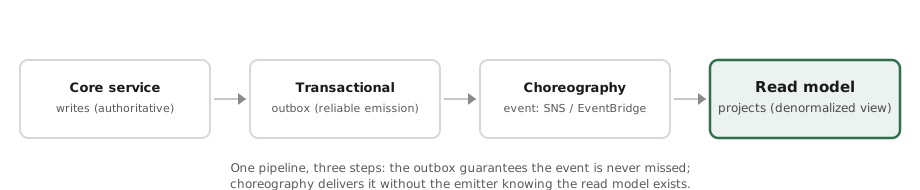
- The outbox guarantees the read model never misses an event.
- Choreography delivers events without the emitter knowing the read model exists — so you can add a new view without touching any core service.
- CQRS turns that event stream into fast, cross-aggregate reads the share-nothing write side cannot serve.
When to use it
- Use it for cross-aggregate queries, denormalized views, expensive aggregations/reports, and when read load and write load want to scale differently.
- Don't build a read model for a query a single core service already answers from its own data — that is just a read topic on that service. Reach for CQRS when the query spans aggregates or the read shape genuinely diverges from the write shape; not before.
Checklist
A read model is well-formed when:
- It is a separate, derived store — never a second writer to a core service's database.
- It projects domain events into a shape built for a specific query.
- Projections are idempotent folds, safe under at-least-once delivery and full replay.
- It relies on the outbox so it never misses an event.
- Queries choose read-model (eventual) vs core-service (current) per path, deliberately.
- It stays share-nothing — it owns its read store; nobody else touches it.
See also: choreography (how the events reach it) and transactional outbox (why it can trust them).